
The Complete Guide to PPC and Paid Advertising Management
Google Ads costs $5.42 per click, Facebook costs $0.70. But cost isn't the whole story. Here's the complete guide to PPC management: platforms, process, cost, and how to measure ROI.
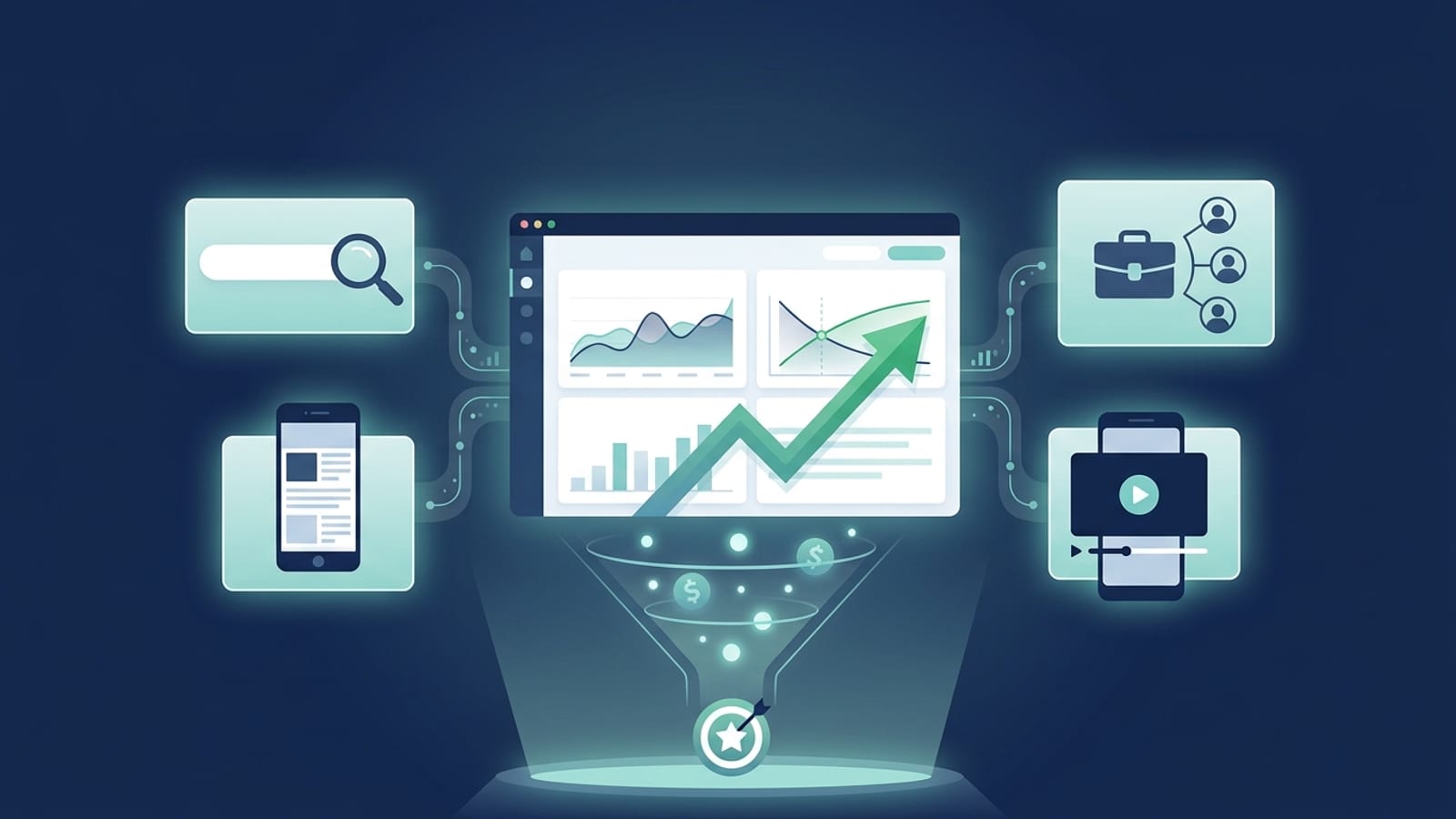
Table of Contents
Why PPC Still Works, When It's Managed Well
Paid advertising still delivers real results when it's done right. Google Ads conversion rates rose across 87% of industries in 2026, according to WordStream's benchmark data. But that same data shows a wide range in performance. Some businesses see strong returns. Others waste budget on campaigns that were never set up to convert in the first place. The difference usually comes down to strategy and management. Not the platform itself.
The Platforms: Where Your Budget Actually Goes
PPC management isn't one task. It's a set of ongoing decisions. Different platforms reward different approaches.
Google Ads
Google Ads captures active buying intent. People searching on Google already want something. They're comparing options, or ready to buy. Google Ads averages a 6.64% click-through rate and a $5.42 cost per click, according to WordStream. That higher cost reflects real demand. Not inefficiency.
Meta and Facebook Ads
Meta and Facebook Ads work earlier in the buying journey. People aren't searching, they're scrolling. Your ad has to earn attention first. WordStream's data shows Meta averaging $0.70 per click for traffic campaigns and $1.92 for lead campaigns. Click-through rates run around 1.71-2.59%. Lower cost, but a different job to do.
LinkedIn Ads
LinkedIn Ads reach decision-makers by role, industry, and company size. Not just broad job titles. This is the platform for B2B. The buyer isn't a consumer scrolling for entertainment, but a professional evaluating a business decision. Costs on LinkedIn tend to run higher than Google or Meta. That reflects how specific and valuable the targeting actually is.
TikTok Ads
TikTok Ads need to feel native to the platform. Not like a repurposed video ad from somewhere else. Content that looks like an ad gets scrolled past. Content that looks like a real video gets watched. It's an especially strong fit for reaching younger audiences early in their decision. Well before they're actively searching for anything.
Retargeting
Retargeting deserves its own mention. It works differently than any of the four platforms above. Rather than reaching new people, retargeting brings back visitors who already showed interest but didn't convert. This is often the highest-return part of a paid strategy. You're spending to reach people who are already familiar with your brand. Not starting from zero.
For the full breakdown of when to prioritize Google over Meta, and why the cost gap between them exists, see: Google Ads vs. Facebook Ads: Where Should Your Budget Actually Go?
PPC Terms Worth Knowing
A few terms come up constantly in PPC management. It's worth knowing what they actually mean before a conversation with an agency or freelancer.
CPC is cost per click. What you pay each time someone clicks your ad. CTR is click-through rate. The percentage of people who see your ad and actually click it. CPA is cost per acquisition. What it costs to generate one actual conversion, a sale, a lead, a sign-up. ROAS is return on ad spend. It measures revenue generated against what was spent to generate it. Quality Score is specific to Google Ads. It rates how relevant your ad, keywords, and landing page are to each other. It directly affects how much you pay per click.
The PPC Campaign Process, Start to Finish
A typical PPC campaign moves through four stages. Whether it's a single campaign or an ongoing program.
Strategy and Audience Research
Strategy and audience research comes first. This is where goals, target audience, and platform choice get defined. Before a single dollar is spent. Skipping this step is the most common reason campaigns underperform.
Campaign Build
Campaign build is next. Ad copy, creative, targeting, and bidding structure all get set up here. A rushed build usually shows up later as wasted spend.
Launch and Optimization
Launch and optimization is ongoing. Not a one-time event. Campaigns need regular attention: testing new creative, adjusting bids, refining targeting. Not a set-it-and-forget-it approach.
Reporting
Reporting closes the loop. Clear, regular reporting tied to actual business outcomes, not just clicks and impressions, is what tells you whether the campaign is actually working.
How Much Should You Actually Spend?
There's no universal right number for how much to spend on paid ads. But there are useful starting points. A common rule of thumb is to budget 5-10% of revenue toward marketing overall, with paid ads making up a portion of that. For a new campaign, it usually takes real budget and a few weeks of data before a platform's algorithm has enough information to optimize well. Underfunding a test, then judging it as a failure after a few days, is one of the most common ways businesses write off a channel that might have actually worked.
In-House, Freelance, or Agency: How to Decide
One of the biggest decisions in PPC management is who actually runs your campaigns. An in-house hire. A freelancer. Or an agency.
An in-house PPC hire typically costs $100,000 or more a year in salary alone. Before software and training. Freelance PPC specialists typically charge $75-200 an hour, depending on experience. Agencies usually charge differently. Through a flat monthly retainer, most commonly $1,000-5,000 a month, or a percentage of ad spend, typically 10-20%.
That percentage matters more than it looks at first glance. On a $5,000 monthly ad budget, a $1,500 retainer isn't just "$1,500." It's 23% of every dollar going into the campaign that month. Worth doing that math for your own budget before comparing providers on sticker price alone.
Freelancers work well for straightforward accounts or smaller budgets that don't need daily attention. But you're limited by one person's bandwidth. If they're sick, on vacation, or juggling other clients, your account management pauses. Agencies tend to make more sense once you're spending over $5,000 a month and need to scale quickly. You're getting a full system, not just one person.
Common PPC Mistakes
Even experienced advertisers make the same handful of mistakes.
Launching without a clear goal is the most common one. A campaign optimized for clicks instead of actual conversions can look successful on the surface. While doing nothing for the business.
Ignoring landing page quality is another. The ad gets someone to click, but a slow or confusing landing page loses them right after. The campaign gets blamed for a problem that's actually downstream.
Setting a budget and never revisiting it wastes money quietly over time. Platforms change, audiences shift. A campaign that worked six months ago can quietly stop performing without anyone noticing, if nobody's checking.
And choosing a provider based only on the lowest retainer, without asking what's actually included, often costs more in wasted ad spend than the management fee ever saved.
How to Measure PPC ROI
A campaign isn't done once it launches. Tracking what it actually delivers matters as much as getting it live.
Watch conversion rate and cost per conversion. Not just clicks or impressions. A campaign with a high click-through rate but no real conversions isn't working, even if the surface metrics look good.
Track return on ad spend. The actual revenue generated against what was spent to generate it. This is the number that tells you whether the campaign is profitable, not just active.
And give campaigns real time before judging them. Early results are often noisy. Most platforms need real budget and time to gather enough data to optimize properly. Not just a few days.
Work With Digital Lab
This is exactly what our ads management services are built around. We manage Google, Meta, LinkedIn, and TikTok campaigns with a dedicated team. Real reporting tied to business outcomes. And a strategy built around where your specific customers actually are, not a one-size-fits-all platform choice.
Conclusion
Paid advertising isn't one thing, and neither is managing it well. Where your budget goes depends on where your customers actually are in their decision. Who runs your campaigns depends on your budget and how much attention the account needs. And whether it's actually working depends on tracking the outcomes that matter, not just the numbers that look good on a dashboard. Get those three right, and PPC becomes one of the more measurable investments a business can make.
Frequently Asked Questions
PPC management covers the ongoing strategy, setup, and optimization of paid ad campaigns across platforms like Google, Meta, LinkedIn, and TikTok, including targeting, creative, budget decisions, and performance reporting.
Freelance PPC specialists typically charge $75-200 an hour. Agencies usually charge a flat monthly retainer of $1,000-5,000, or 10-20% of ad spend. In-house hires typically cost $100,000 or more a year in salary alone.
Freelancers work well for smaller, straightforward accounts. Agencies tend to make more sense once you're spending over $5,000 a month and need to scale, since you get a full team instead of one person's bandwidth.
It depends on your customer's stage. Google Ads captures people already searching to buy. Meta and Facebook reach people earlier, before they're actively searching, at a lower cost per click.
Watch conversion rate, cost per conversion, and return on ad spend, not just clicks or impressions. A campaign can have strong surface metrics and still fail to generate real revenue.
Launching without a clear conversion goal is the most common mistake, followed by ignoring landing page quality and setting a budget that never gets revisited as performance changes over time.
Retargeting shows ads to people who already visited your site or engaged with your brand but didn't convert. It's often the highest-return part of a paid strategy, since you're reaching people already familiar with you rather than starting from zero.
There's no universal number, but a common starting point is 5-10% of revenue toward marketing overall, with paid ads as one part of that. New campaigns usually need a few weeks of real spend before there's enough data to judge performance accurately.